Idle thoughts
From the front lines of the War on Gas-powered cars
This week, the Town Council decided that Wakefield should comply with a virtually unknown, 15-year-old state regulation requiring “No Idling” signs to be displayed on school grounds.
The issue came up after Councilor Bob Vincent did one of his signature deep dives into the legal weeds. Based on what he found, the Traffic Advisory Committee was asked if Wakefield was required to erect “No Idling” signs at local schools.
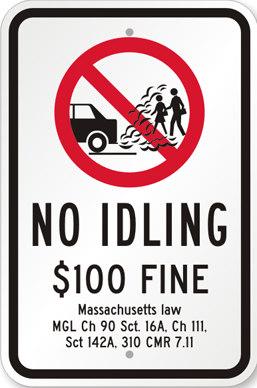
The chairman of the TAC, Police Lt. Joe Anderson, sought a legal opinion from Town Counsel Tom Mullen.
“We have no known need for the signage in town,” Lt. Anderson wrote to Mullen, “nor do we have a public push to have the signage installed.”
But Mullen wrote back that Vincent was correct and the town should erect no idling signs on school grounds and cited the relevant state regulation. The law allows for penalties of $100 for a first offense and $500 for second and subsequent offenses.
As Lt. Anderson observed, there has been no public hue and cry clamoring for “No Idling” signs. Nor has the Commonwealth threatened to withhold grant funding, which lately seems to be the standard for complying with state law.
Lt. Anderson told the Town Council that he had called around to various communities and found that most did not have “No Idling” signs displayed around their schools.
As a practical matter, do we really need more signs that no one will obey cluttering the landscape? Drivers barely acknowledge STOP signs. What makes anyone think a sign is going to make a mom turn her engine off on a freezing cold day while waiting outside the Dolbeare School to pick up her “kiddo?”
Don’t tell anyone, but it’s not just illegal to idle your car’s engine outside of a school. It’s illegal to idle ANYWHERE in Massachusetts. Is Wakefield prepared to erect “No Idling” signs throughout the entire town? It’s “the law,” after all.
According to the nice folks at the Massachusetts Department of Environmental Protection, “The law limits unnecessary engine idling to five minutes. Drivers sometimes wonder when idling might be considered necessary.”
For motorists struggling with such burning questions, the DEP has published a helpful FAQ listing certain instances in which idling is deemed acceptable.
“For example, running the engine to operate the windshield defroster to clear a windshield of ice on an extremely cold day is a good example of necessary idling,” the DEP explains in a good example of redundancy.
“It’s a safety problem if you cannot see where you’re going and if the windshield is not warm enough to melt snow and freezing rain while driving,” the DEP continues. “Running the engine while actively clearing snow and ice off the vehicle and to warm the windshield and interior of the vehicle is necessary idling.”
So, the state will permit us to use our car’s windshield defroster. May we use the windshield wipers too? I may need to seek a legal opinion on that.
Several people, including the chairwoman of the Environmental Sustainability Committee, contacted the Town Council urging them to erect the no idling signs at the schools. Presumably, they would favor such signs elsewhere around town as well.
Maybe residents who feel strongly about getting the “no idling” message out could put signs on their own property. They’ll look great next to the “Fight Hate” signs. I’m sure they’ll be every bit as as effective.
There are countless laws on the books that that are barely recognized and not enforced. Sometimes it’s okay to leave well enough alone.
But that’s apparently not in our DNA.
The anti-car movement has adopted a “death by a thousand cuts” approach. Bike lanes, eliminating parking, transit-centered zoning and anti-idling laws are all designed to make driving less attractive in a hundred small ways because slow, incremental change is less likely to spark resistance.
The war on gas-powered cars continues.
—
[This column originally appeared in the November 7, 2024 Wakefield Daily Item.]
Filed under: Columns & Essays, Humor, News, Opinion, Politics, Wakefield | 2 Comments
Tags: automobiles, bike lanes, cars, DEP, drivers, Fight Hate, fossil fuels, gasoline, Humor, idling, laws, Lt. Joseph Anderson, Mark Sardella, Massachusetts, MassDEP, motorists, No Idling, Opinion, parking, Politics, Robert Vincent, schools, signs, Stop signs, Thomas Mullen, Town Council, Traffic Advisory Committee, trucks, Wakefield Daily Item, Wakefield MA, Wakefield Public Schools
Flickr Photos


 Mark Sardella
Another government rule that no one pays attention to. Once one is part of government, they seem to believe it is their duty to tell everyone how to live their lives, even on a cold day. But the people who make and are paid to install said signs are happy. I wonder if they will be installed when the temperature is well below freezing and the wind is howling?
This is a forty year old law that actually made sense when applied to the cars of the 1960s and 1970s, cars without fuel injection, computers or (modern) catalytic converters — the problem is that they would be idling at full choke with black soot coming out the tailpipe. Today, particularly in cold weather, there is less total pollution if the engine and catalytic converter remain hot — remember that the converter doesn’t work below 400-500 degrees with a lot of nasty stuff instead going straight out the tailpipe. It’s feel-good environmentalism — these folks simply do not know their science. It’s like Hydrogen Hydroxide, it sounds scary and everyone thinks the “Hydroxide” makes it caustic, e.g. Sodium Hydroxide (aka “Draino”) which is caustic. But this is water, without which life on this planet could not exist. But the larger issue, and I suspect this is where Lt. Anderson is going, the more you clutter the streetscape — the more time motorists spend reading street signs — the less time they spend watching for children running in front of them. So which value is more important to affirm — that we put up signs so we can feel good about ourselves, or that we don’t because we care more about the safety of our children? It’s the same thing with North Ave, which is going to be a foot too narrow to get a fire truck down the middle in an emergency. Feeling good about ourselves doesn’t help the person bleeding to death for the want of a fire truck or ambulance…. And if the goal is to “obey the law”, the Wakefield Schools could always obey the Federal law mandating that the US Constitution be taught, or the state law requiring the Massachusetts law be taught — or perhaps both laws….